In 1979 I crossed Canada by train. Westbound I took CNR's Super
Continental.
The return trip was on the train known as The Canadian -
the Canadian Pacific's premier passenger train, which first ran in the
mid-1950s.
Winnipeg
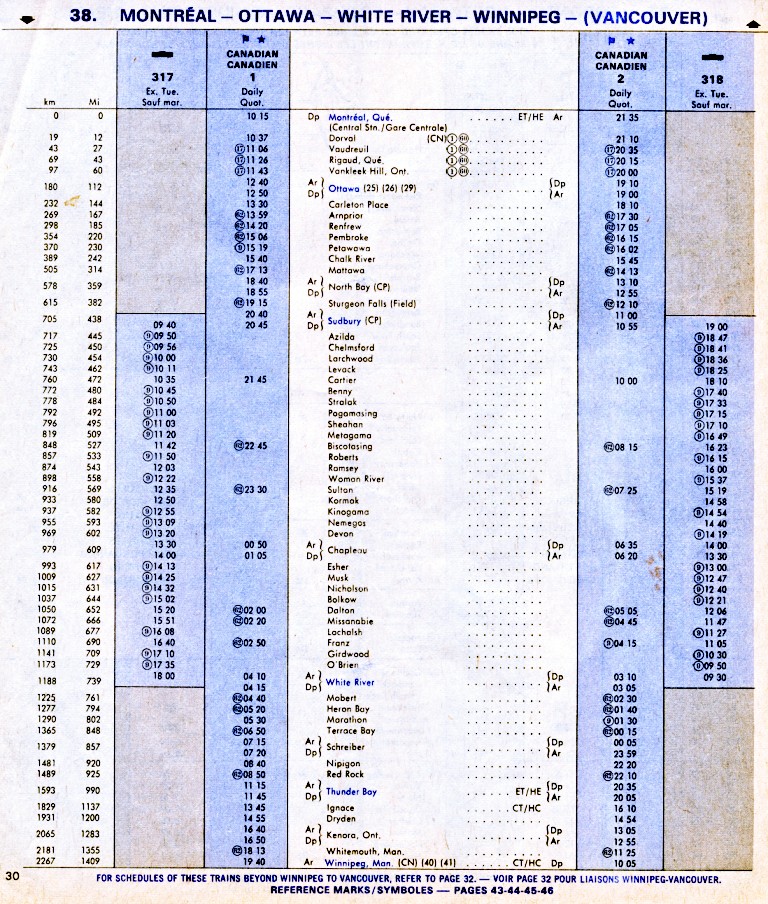
Here again is the timetable that made the trip with me.
For this part we are reading the column for Number 2 from bottom to top.
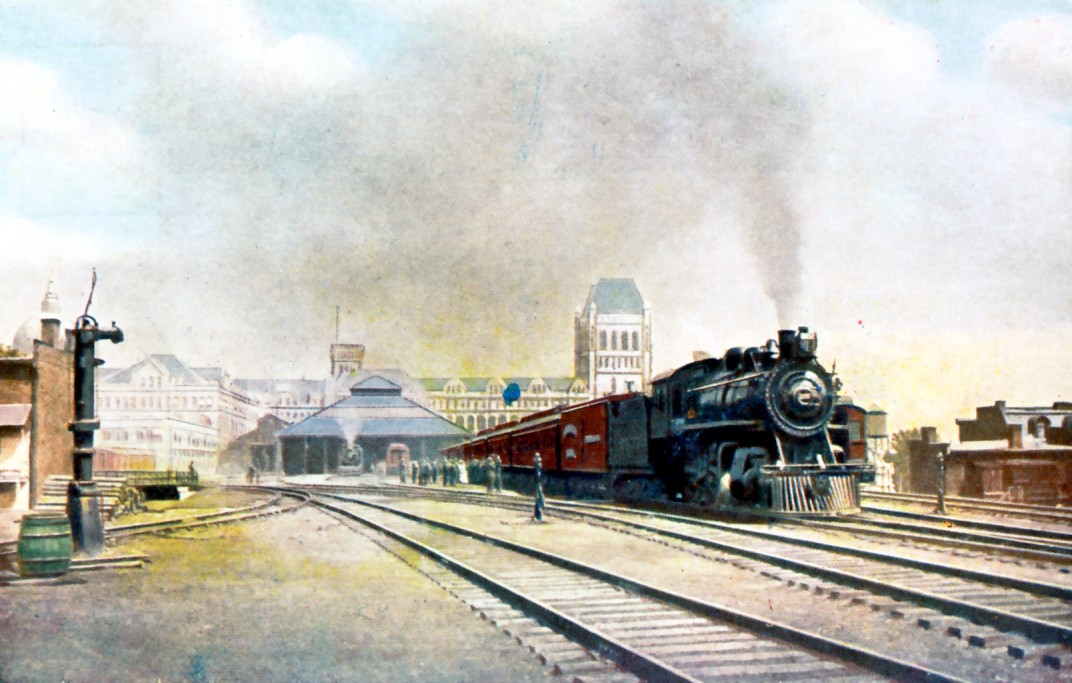
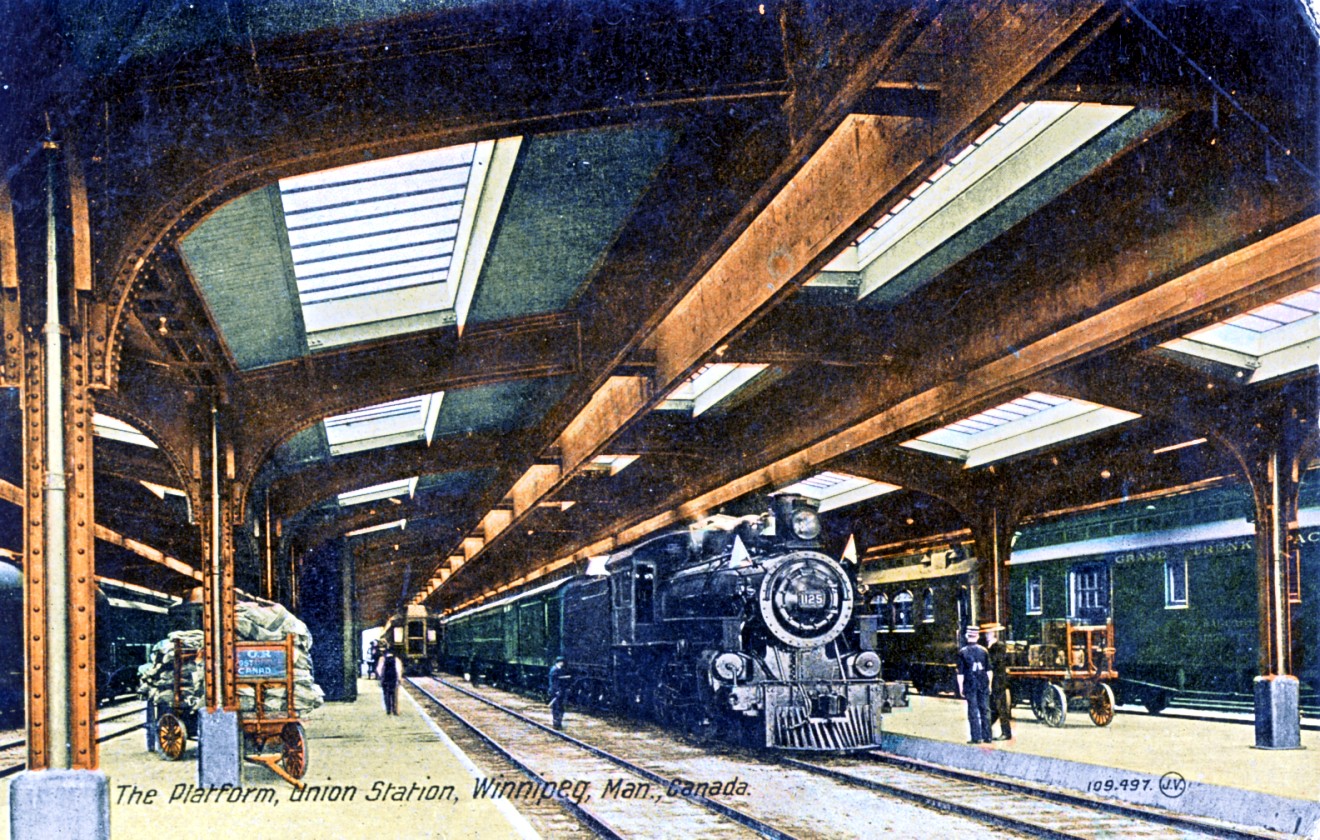
Below is a postcard of Winnipeg Union in the good old days.
The train facing us is Canadian Northern.
The CNoR locomotive number plate design was used as the Canadian National Railways standard for steam until 1960.
At the right, you'll notice a Grand Trunk Pacific train.
Without magnification, I thought the baggage wagon at the left belonged to another railway, but realized that
GR was actually
George Rex.
(i.e. The Royal Mail, now Canada Post)
Time travel forward with me to 1979 - just a couple of weeks before the Mississauga disaster.
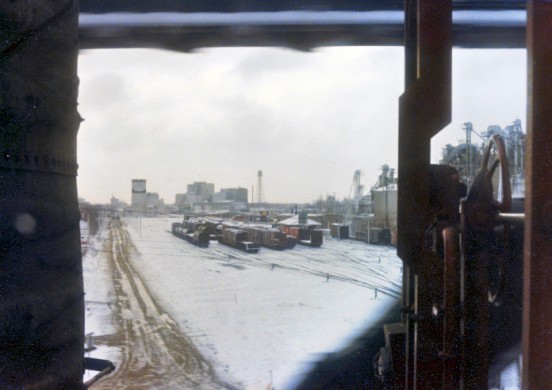
The Canadian is leaving Winnipeg in early November.
We are pacing a CNR freight over a bridge,
with the caboose's brake wheel visible to the right, and a boxcar end to the left.
My brother Eric (having a speciality in prairie elevators and western railway operations)
has identified this as CPR's St Boniface industry support yard ...
Today, the Ogilvie and other grain and flour related buildings, bordering the distant end of the yard, are gone ...
classic grain elevator to water tank, inclusive.
As well, the hip roofed station behind the bulkhead flatcar is now gone.
"
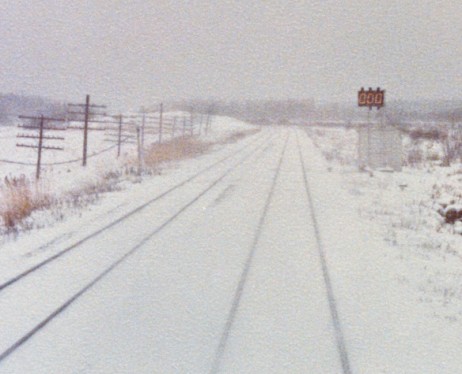
All zeroes on the scanner, Number 2"
When the CPR still had vans on the tailend, the first automatic "hotbox detectors" had a digital readout
to tell you at which axle your hotbox or other defect was located ...
and flashing lights below and above to pin down the type and location of the defect more precisely.
The tailend flagman, trainman, or conductor would radio the information to the headend for acknowledgment,
and action if necessary to stop and inspect.
Here,
The Canadian has just passed a detector and no defects are indicated.
By the time humans were finally zapped from the tailend,
these detectors had learned how to speak !
Just an instrument case and an antenna were visible - no digital display.
Years later, passing a detector, the crew would hope to hear an all clear message.
In an electronic Mr. Rogers voice, the detector would slowly and calmly say :
"CP detector ...
Mile ...
Two seven point five ...
Kee..wa..tin Sub ...
Total axles ...
four ... eight ...
No alarm ...
[The earlier ones repeated this whole thing again, then ...]
Message complete ...
Detector out"
If you analyze the message, you'll see it complies with the appropriate procedures for licensed two-way radio posts :
Owner, location of the transmitter, message, then it signs off.
And you already know that Mr. Rogers never lost his licence for swearing on the air !
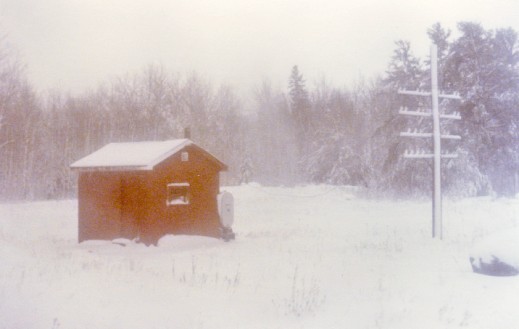
Somewhere in north-western Ontario,
the snow continues to make things picturesque
and we pass a wayside shelter with a telephone to the dispatcher.
The telephone wire dips down from the wayside pole and enters just above the oil tank.
During an emergency in bad weather, this simple shelter could be a lifesaver.
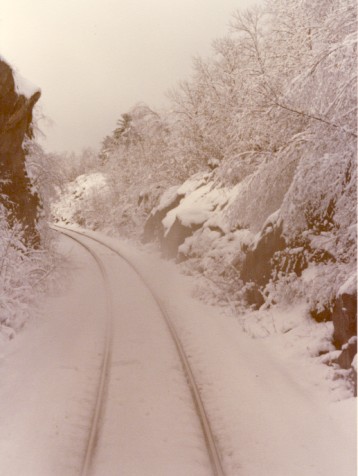
Picturesque-er still.
A little freezing rain is mixed with the wet snow.
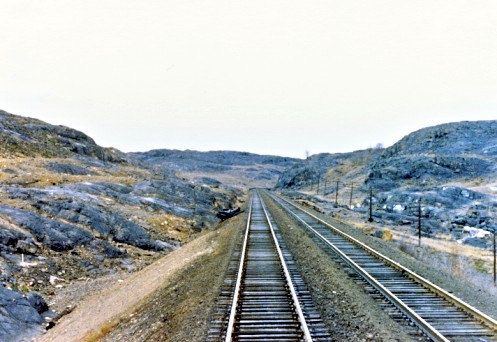
The CPR line slices through the eternal Canadian Shield.
We passed through the scenery of Lake Superior in the dark.
My dining companions that evening were from England.
One of them, who organized the electronics for rock concerts,
was saddened by the fact that the VIA waiter swiped his salad dish before he was finished.
All the "good juicy bits at the bottom" were lost to him as we travelled along in the wintry gloom.
... just one of the many memories you store away for decades, from transcontinental rail travel.
THIRD NIGHT ON THE TRAIN (since Vancouver)
SUDBURY
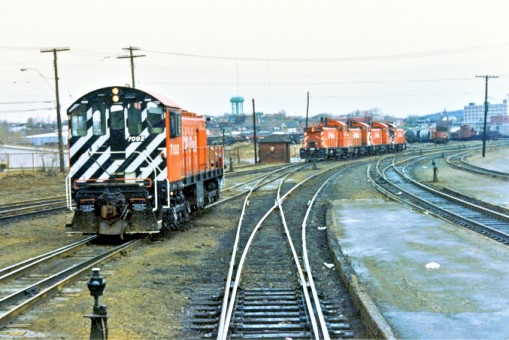
Oh, to travel back to the time of an MLW/Alco switcher.
At Sudbury station, they're still using kerosene switchlamps in the yard.
The switcher approaches, knuckle open to make the joint.
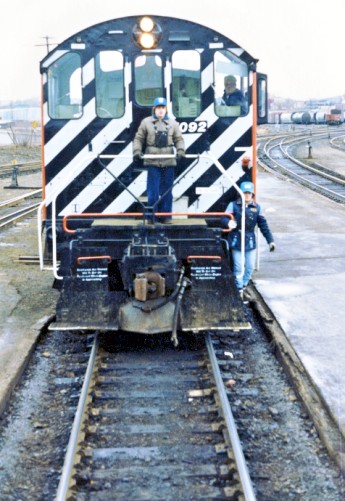
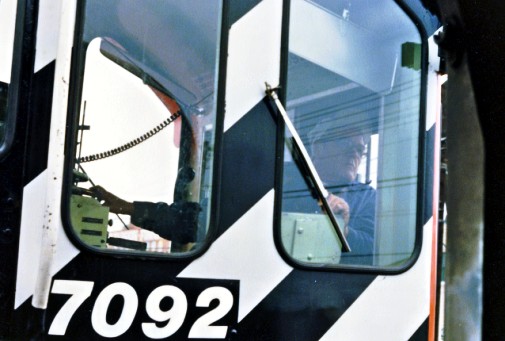
The three-man crew is alert to the dweeb with the camera in the open vestibule.
With a cigarette in his left hand resting on the seat back,
and the radio handset hanging from the whistle cord by his right elbow for ergonomic reasons,
the switcher engineer looks back along the movement he is controlling.
Where on earth could could we be?
With the new SuperStack broadcasting the smelter's sulphuric acid plume over a wider area,
the vegetation will soon be coming back locally in Sudbury.
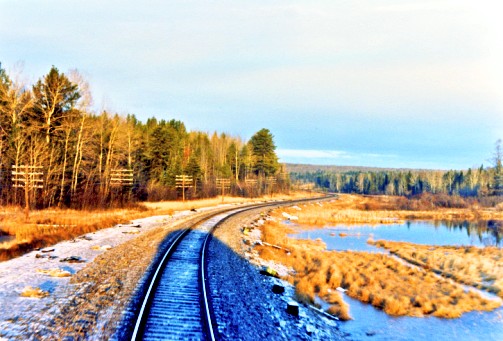
We sweep around super-elevated curves in the Ottawa valley,
roughly following the route taken by the Voyageurs.
We are probably near Pembroke or "The 'Frew".
The light is perfect as we head "timetable east" toward Montreal ... and into the sunset !
MONTREAL
After arriving in darkness at Montreal ...
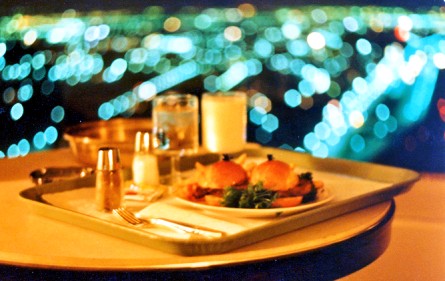
a room service steak sandwich came up from the kitchens of the CP Hotels Chateau Champlain.
The glass of milk is a salute to Quebec's dairy farmers.
Windsor Station's outbound dwarf signals can be seen glowing red at the right edge of the photo.
From my room in the Chateau Champlain on a Sunday morning,
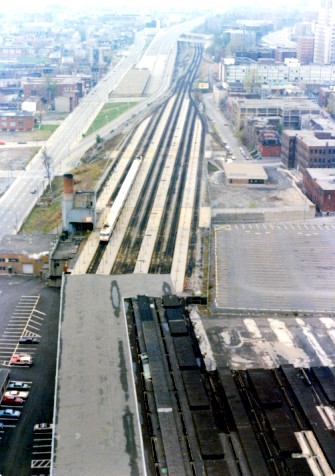
the old train sheds of Windsor Station are visible in the foreground.
The "healthy fresh-air tracks", now used mainly by west island commuters
appear to the west along with an Amtrak Rohr Turboliner.
I have heard different versions of a story which bestows the title
"The Leaky Roof"
on one Canadian railway or another.
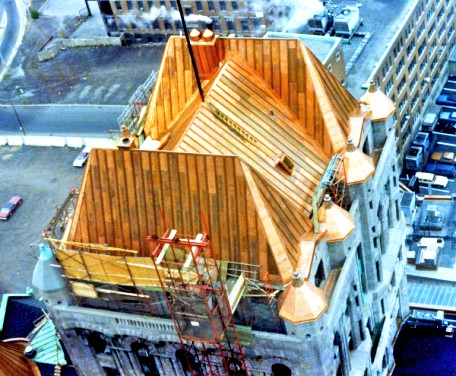
As they put new copper roofing on Windsor Station's tower
where the CPR archives once were housed,
we know that at least one roof won't be leaking for a while.